Do you still think you need to be connecting to everyone in Social Media? After Farmville and Mafia Wars, the biggest games on Facebook involve your data.
Audio clip: Adobe Flash Player (version 9 or above) is required to play this audio clip. Download the latest version here. You also need to have JavaScript enabled in your browser.
(Note: The sequel is now live)
Identity Crises
I’m connected to many different circles of people from different times in my life. I’ve got connections to work, to church, to hobbies, and to places I’ve lived and gone to school. Also, because I spent so many years on the air as a TV reporter, I’m fairly recognized in the area where I live.
When I get requests to connect on Facebook, I can tell pretty much at a glance how I might know someone. If I have 40 mutual friends who are all classmates of mine from Idaho, then I can figure out who it is quickly. If it’s 20 mutual friends all from one of my TV employers, I can also zero in.
 I’ve turned down hundreds of requests in the last couple of years, and I’ve been called nasty names for doing so. In all of these instances, it’s been a blind approach from someone I’ve never met, who just happens to be connected to 30 of my friends in the media. It’s clear that they don’t know any of these anchors, reporters, editors or columnists — they are just grabbing as many “local celebrities” as they can. (While I am flattered to be a “local celebrity,” I’m also a little insulted that I would have no value other than being another digit in someone’s online Pokemon collection.) NOTE: If you just say “Hello,” that makes a world of difference.
Maiden names are also an issue. When a friend from high school sends an invitation, with a picture of her kid and an unfamiliar surname in the profile, I can be lost. That’s where the personal introduction can help, and lacking that, the Mutual Friends comparison for context.
Ghosts From My Past
 About a year ago, I got a friend request from a woman named Cindy Robertson. I didn’t remember her, but she and I shared more than 30 friends, all of whom were movers and shakers in Birmingham. They were not all media people, so it wasn’t the “Pokemon Syndrome.” I went ahead and added her.
Over time, I noticed she was adding a lot of friends. I’d get notifications that she was friends with 20 more people, all here in Birmingham. Many were friends of mine.
A couple of times, I clicked on her name to see if I could figure out a little more about who she was. Oddly, she never added new links, or commented on other people’s items.
I started to get paranoid, so I created a new Friend List called “UnTrust.” People on my UnTrust list would get even less access than people who weren’t even logged into Facebook. I locked her out of everything I could. Including the list of my friends.
Then I went back through her timeline. All the way back. And in months of activity, I found exactly FOUR times when she made a comment. It was always in response to something another person had placed on her wall, and it always included a little “:)” at the end.
I wondered about who this is, and what he/she is up to.
Project Sherlock

Click to enlarge
I spent some time cataloging what I could of this profile.
The more I saw, the dumber I felt for not seeing it earlier.
But before I outright accused someone of being a fraud, I wanted some other opinions. I reached out to six of my “common friends” with Cindy, and I picked six that I knew didn’t know each other. I asked them if anyone knew her personally, or had met her. And I asked them to look at the profile with the same rigor. Nobody knew her.
I also told them about my UnTrust list, and I’m pretty sure they quickly created that privacy setting for themselves.
I then confronted “Cindy Robertson” through email, Facebook Chat and the Facebook Inbox. I got no answers, but was instead blocked from seeing her profile.
The Evidence
Fortunately, I’d already compiled an archive of screen captures.
Let’s start with that status update:

Her profile does indicate that she likes to run. Look at her personal information. (Remember, these screen caps were taken several months ago, prior to Facebook changing all the rules about “Likes.”)

I found it highly interesting at the time, as she listed “Alabama Football” as an interest, yet went through the entire period from the SEC Championship Game to Alabama’s BCS National Championship without mentioning it at least once.
Let’s look a little closer at her personal life, as reflected in the stream.

Shortly after joining Facebook, Cindy listed herself as single and mentioned her job working for Texas Instruments.
Then she started decorating her downtown Birmingham loft.
Please note the gratuitous use of the smiley-as-period-replacement. We’ll see that again later, such as in this very rare update, indicating a rather masculine pursuit:

A female football fan who doesn’t mention football, but goes hunting instead? There’s really no evidence she was out much of anywhere, save for a couple of Facebook Events she clicked on. (Look at the descriptions of the parties below… tell me if they’re indicative of compatible interests… then hold on to that thought, because we’ll stitch it all together shortly.)


Every Picture Tells a Fiction
Her photo albums were quite revealing.
We’ll start with her good fortune in getting “In a Relationship” even though she’s been hard at work for Texas Instruments, traveling to Atlanta for seminars, going to late night Mayhem with the Naked Eskimos Concerts, followed by another Friday night of Latin dancing.
Or maybe she met her beloved while not watching Alabama football, or while freezing her butt off in the deer stand.
Do you think he sits at the end of her bearskin rug, massaging her feet while she reads him the Cosmo quiz?
No. She’s got to take care of her kids. To the Albums!

That “Kids and Family:)” album shows some promise. What would we find in there?

Looks to me like at least four different children. Not a bad looking brood for a single mom under the age of 30!

 Maybe she’s making some side income on the residuals from her children’s pictures.
The one with the happy naked baby wearing the orange and hot-pink knit cap? It’s a stock photo that’s been used on dozens of websites. (Here is the reverse image search from Tin Eye if you haven’t seen enough of him yet.)
If you have any doubt, the boy in the red hat was in kindergarten back in 2002, when this picture was submitted to iStockPhoto by Erick Jones.

Also, why all the pictures in the snow? I’ll buy a trip to see grandma and grandpa up in Buffalo, but how come there’s no indication in any of the pictures about where they were taken? (We didn’t get THAT much snow in Birmingham.)
As an aggregate lie, these little lies add up to at least four children for this under-30 single mom who has time to hunt, date, go to parties and out of town on business. It’s a good thing she’s always on the go, too, because her digs are looking rather sparse.


I’m fairly certain that if you wanted to give Tin Eye another couple of runs at those pictures, you’d find them online elsewhere. I don’t have to. As a reporter, I did several stories about the resurgence of Birmingham’s downtown loft district, and can tell you that none of them look like that. They all take advantage of older architecture, and rustic brick walls. They are beautiful in a historic way, and do not resemble the “Do-it-yourself Surgical Theater” in the IKEA catalog.
The rest of her wall photos (yes, just two of them) are also revealing in their lack of revealing anything.


The generic box might contain “Do-it-yourself Oxygen” from IKEA, gift-wrapped in time for the holidays. But the failure to cut out the title from the “Yoga Community” banner is just an outright lack of effort. Shame on you, fake Cindy.
The Confrontation
 Loaded with the screen captures (even more than shown here,) I decided to ask the world’s foremost expert on Cindy Robertson. I started with the email address associated with the account, the very apt [email protected]. (Gosh, did I just share that email address publicly?)
Heh.
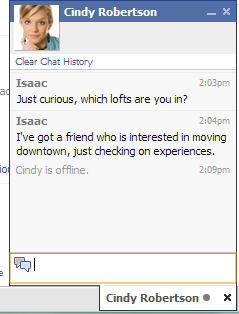 After several innocuous inquiries spread over several days with no response, I caught the little green dot that meant she was online and available on Facebook Chat.
I figured that she’d respond to a question about living in the lofts downtown. After all, she had been so kind as to share her home with us in pictures, and listed several hobbies and interests that would indicate she might know something.
“I’ve got a friend who is interested in moving downtown, just checking on experiences.”
As you can see, she bailed on the chat session without a response.
Finally, I resorted to Facebook’s Inbox. Maybe if she’s just too busy, I can catch her for a volley of messages in between things. I initiated a thread on January 7th, just before Alabama’s national championship game. She answered late that night, but didn’t respond to my follow-up. (Note… she also didn’t talk about the results of that game, anytime between January 8th and January 26th, at a time when many female Bama fans were so giddy, they wrote they’d gladly leave their husbands for Nick Saban.)

Notice the nice, thoughtful and pensive picture on her avatar. It’s there in the morning. But a couple of hours later, she responds and then blocks me. (At the time, I was getting time-stamp discrepancies when posting with my mobile phone.)

I’m pretty sure she’d never been interviewed, either. Until now. And the last thing I saw was the smiley.
The Game of Access
I’ll never know for sure who is behind the fake Cindy Robertson account. But I have some educated guesses, based on the clues presented.
First, if you’re going to do a bogus profile, it’s got to be a woman. You can parlay that maiden-married name confusion into a lot of additional Friend Request acceptances from people who just aren’t quite sure, or can’t turn down a girl with a pretty face.
Second, it helps to leverage existing friends. Fake Cindy reeled me in, then went through my friend list to seek out others. In doing so, he/she was trucking on my reputation to get others to accept. I don’t know how many people clicked “Yes” simply because my face was there along with other friends in common. (And if you’re one of them, I’m sorry.)
What is this perpetrator after? Information. Not identity theft stuff. Here’s my theory. We’re looking for a man in the Birmingham metro area who is involved in real estate. Look again at the interests to the right. We have both “Real Estate Investing” and “Flipping Houses” listed. One presumes the sort of money an under-30 single mother would likely NOT possess, the other is expressed in a very masculine way. Women tend to refurbish or restore homes. Men “flip” them.
Also… not to sound terribly sexist here, but “Motivational Seminars” and “Anything by Zig Ziglar” are not in the XX-Chromosome camp. She/he might as well have included Rush under the Favorite Music. (Although, having been to see Rush recently, I’d bet the concert was less of a sausage-fest than a Zig Ziglar book signing.)
Add it all up, and the profile points to a male in his 40s or 50s, who works in real estate and can’t spell either “Forrest Gump” or “Steel Magolias.” He also thinks women should end all of their sentences with smiley faces:)
 Why would he bother creating a fake profile and becoming friends with literally thousands of middle-to-upper income people in Birmingham?
Wait, did you really just ask that question?
Most people aren’t aware of Facebook’s quite robust search feature. You can search for people, pages, applications, and posts across all of Facebook.
Or, you can narrow your search results to the network of Friends you have built.
You know… that rich database of thousands of well-off, upwardly-mobile people in your target demographic and exact geographic location. That network you worked so hard to build.
Every day, you go in and you mine that network for keywords like “moving,” “yard too small,” “new job,” “relocation,” “real estate,” and God only knows what else works. When you find those people, you mail them a flier, or some other seemingly innocent contact that just by fate happens to land in their laps at the exact moment when they might actually want to find a competent real estate agent.
It’s brutal in its genius, as it is ruthless in its ethics.
So, you want to know why I stopped accepting each and every generic invitation on Facebook and LinkedIn? You want to know why I am a little suspect about “mutual openness” and “reciprocity” and the Kumbaya Chorus of Social Media? You want to know why I think Mark Zuckerberg is a child, playing around with incredibly powerful technologies while harboring ridiculous idealistic fantasies about Total Transparency and a post-Privacy culture?
I won’t answer those questions. Go ask Cindy.
(…or find Renee Brantley, the star of the sequel.)

if I had penny for every sucker that falls for a pretty face.. lol
…then you’d be stacking a LOT of unnecessary change!
The most brilliant part of your detective work is that you were able to fool the readers into thinking that you don’t know Cindy. When in reality, Cindy is a carefully crafted plot that YOU concocted with the intent of exposing for your own notoriety.. Bah buh bum! Didn’t you, Mr. Pigott with the Profile in the Library?
Nope.
It was the Candlestick.
You lose, so you have to shuffle and reset the board. I’ll pop more popcorn. Monopoly instead?
Excellent job, sir! I’ve been waiting for this post for a long time! You took your time and researched what we “untrust” fans knew. Using stock photos for a living, they all look alike. Knew they were fakes, but glad you discovered where they came from. Wish you were still in the reporting biz. Miss you!
Jenny, thanks for your help on “Team UnTrust.”
It’s nice to be missed, but I don’t miss TV.
Ooh, Ike a creepy story just in time for Halloween. This one tale masterfully told (throw in a few stock photos) is worth a thousand “how to” lists. I don’t think there is a better illustration of why smart and safe behavior is as necessary in virtual networks as in real life. Wait, they often begin with or lead to face to face connections. As games go, I prefer Diplomacy. Thanks, Ike. I hope word of this post spreads like wildfire. Off to do my part.
Diane, you make an important point:
Many people assume these shenanigans would never happen, because they can’t fathom this information would have any value to anyone else.
The timing is purely coincidental.
Thank you!
Great post. We had someone in our community use dozens of fake profiles to make it appear that certain political candidates or fanpages had lots of interest and engagement – when in fact it was only one person.
I, too, used the “mutual friends” approach early on, but have since stopped. And I really like your “UnTrust” list idea. I’m definitely going to use it, and go back through my other lists more carefully.
Thanks for the reminder that this kind of manipulation and deception occurs. I think we sometimes forget what people are capable of.
I’ve seen a lot of that too, Kendra. But in those cases, it’s the marketer who is trying to deceive his own client, and padding results that don’t translate into anything (except for maybe a renewed service contract.)
But this is shadier, in my opinion.
Thanks for stopping in!
Really interesting. I had a similar thing with a real person who started mining all women with kids in this area to promote her products. I quickly unfriended and had to warn my friends who were quickly receiving friend requests. It wasn’t as icky and fake as this, but it still seemed wrong. I didn’t know her, but thought I did based on mutual friends. Once I realized what she was up to, I felt badly about my own friend list getting hacked. An important lesson, for sure.
Nicely sleuthed and documented!
Jeannie, at least the person who was doing this in your case was up front about it.
Many people with online profiles don’t mind being pitched to, they feel like they get great deals. And you know, I think it’s smart for people in sales-related professions to use these tools as an extension of their regular business communications.
I draw the line at sneaky, sleazy, underhanded and manipulative. And I don’t like the attitudes of openness that enable the Wolves.
Thank you!
Ike, you’ve shared with us all several very important lessons. As a professional once “stalked” online by a co-worker (who proceeded to manipulate and distort information for his own personal agenda), I know better than many the raw power we unwittingly provide others each day with our social, accessible, permanently available friend-ish overtures. As technology increasingly enables faster delivery and greater access, and as society and culture encourage distant contact that serves in lieu of traditional relationships, we, AND OUR GROWING CHILDREN, overlook the inherent risks. We normalize sharing and openness without much circumspection. We risk our safety, privacy, sense of propriety, and so much more. I’ve had to caution my early teen daughter about texts with friends (what’s understood between 2 today may be shared and misrepresented among many tomorrow) and Facebook status updates (you betcha I’m her friend, and I monitor from a distance).
We’ve all read some horror stories and I hope you pardon me, but Don Henley’s old song “Dirty Laundry” comes to mind – we’re shocked but don’t see ourselves – because we’re much smarter and much more in control – in those situations. Wrong. Just wrong.
Thank you for digging into this, and for sharing. It’s a powerful story and you’re a gifted writer with a mind for putting puzzle pieces together. I’m fortunate to know you, if only from afar.
Gotta go try to figure out which list I’m on. Heh.
You’re on the Nice List, for now.
Santa most definitely scours Facebook for Naughty List material.
Thanks!
We’ve all been waiting for spammers to get past royal inheritance from Nigeria, Viagra schemes and clear abuses of the English language to try to dupe. This is a much more sophisticated exercise, and one that the conspiracy theorist in me wonders if there are much larger paid networks of folks who do this across other platforms. Yikes.
Oh, it’s not a theory:)
And let me know if you happen to uncover any examples of the Social Media Dark Arts along the way.